

Stack Study: Proverbs & the Life of Solomon Lesson 2
A guide for reading and studying Proverbs via Substack | The Way of Wisdom
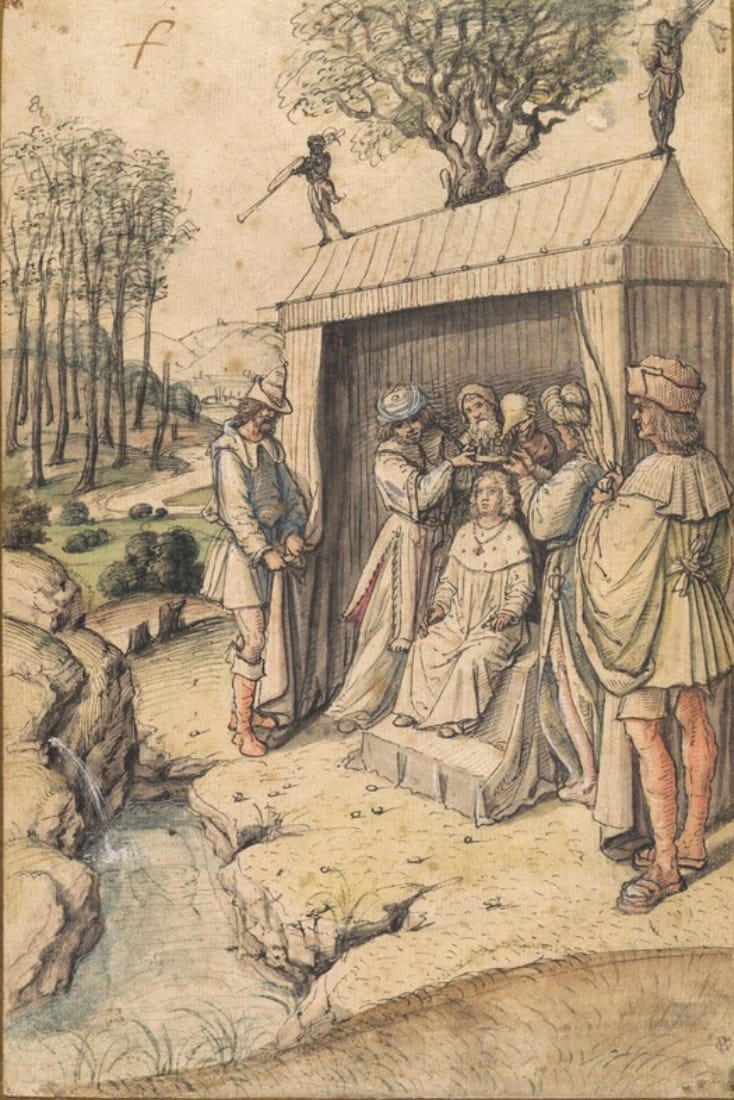
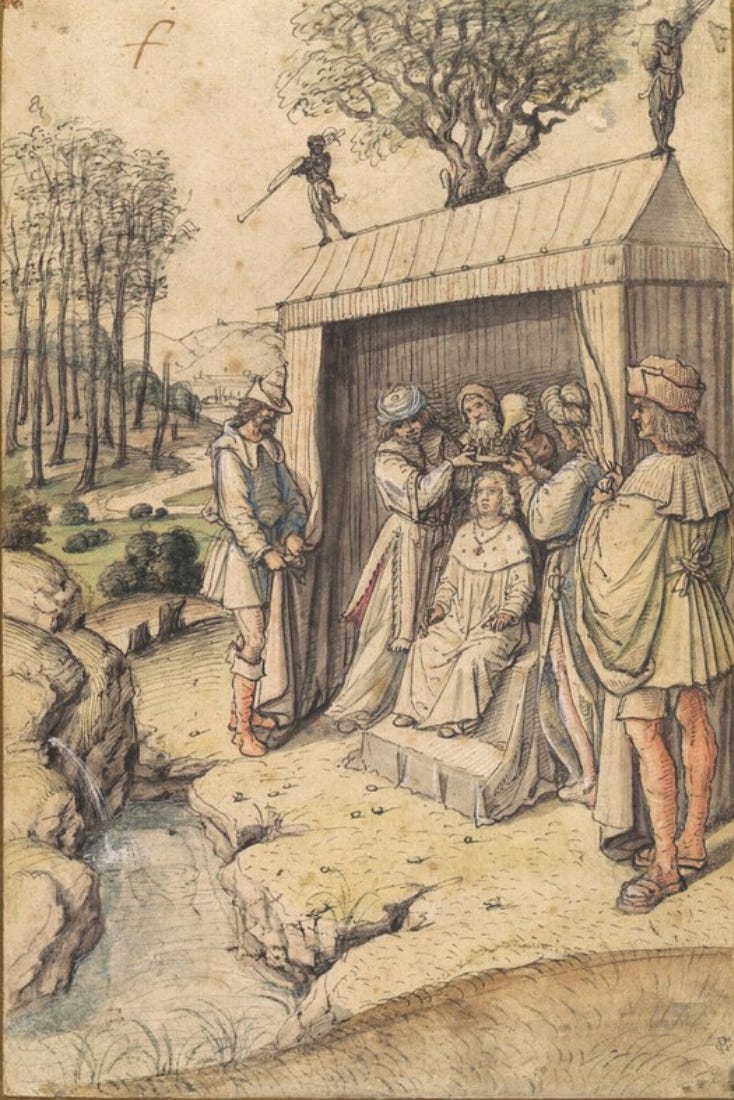
I put art in the bottom of this lesson that I’d really love for you to see.
It’s not mine because no one wants to see that (and because you’re reading what I do to be artsy). It’s the work a 16th century French artist who appears to have lived a rather short life, but who must have read closely what I hope you’re about to read.
Since art is meant to be experienced rather than explained, I’ll resist the urge to dissect this work for you and rather hope you’ll read, contemplate, and think curiously about the Way of Wisdom in Proverbs and the life of King Solomon.
Today’s lesson includes a quick recap, a reading from Proverbs, and the story of Solomon’s anointing as king. If you are new or want to share with a friend, here’s a link to the first lesson.

“My son, if you accept my words and store up my commands within you, turning your ear to wisdom and applying your heart to understanding, and if you call out for insight and cry aloud for understanding, and if you look for it as for silver and search for it as for hidden treasure, then you will understand the fear of the LORD and find the knowledge of God.” - Proverbs 2:1-5, NIV


Proverbs is Hebrew poetry and most scholars credit its authorship to Solomon (outside of the last 2 chapters, more to come on this).
Chokmah is the Hebrew word for wisdom and it means “skill.” Biblical wisdom combines mental activities and practical expression.
Wisdom for a flourishing life comes as a gift from God. It is not found within us.
From the Context Matters section, God promises David that someone from his line will always be on the throne (Davidic Covenant).
Young Solomon asks God for wisdom and God gives it to him along with riches and honor.

In this lesson, we’re zooming in on some beautiful imagery in Proverbs poetry and connecting it to a pivotal scene in the life of Solomon. The first 9 chapters of Proverbs are long-form poems that contain a series of speeches, even speeches within the speeches, and they are structured as a dialogue between a father and sons. Perhaps the father is Solomon speaking to his literal sons, but more likely these are the words of Solomon recorded by a scribe and preserved for his descendants and ultimately all of Israel. You’ll notice the sections alternate between these father/son exchanges and the first glimpses of Wisdom personified.
As what you might ask? A woman, of course.
Wisdom calls aloud in the street, she raises her voice in the public squares; at the head of the noisy streets she cries out, in the gateways of the city she makes her speech. (Proverbs 1:20-21, NIV)

Read Proverbs 3:1-10 - The Benefits of Wisdom
What does it say? Easily overlooked in these verses is a series of if/then statements. Look closely and you will find that the father seems to be saying if you do this, then you will get this. Before we consider our reaction to these claims, let’s make a list. Remember that this section is only about observing what the text says, not jumping to conclusions or reactions.
IF: remember teachings and keep commands, THEN: prolonged life and prosperity
IF: loving and faithful always, THEN: a good reputation with God and man
IF: trust God and not yourself, acknowledge his authority, THEN: straight paths
IF: fear the LORD, THEN: a healthy body
IF: honor God with wealth, THEN: more wealth
Read Proverbs 4:10-19 - Two Paths
What does it say? The pattern is continued and incorporates imagery of a path or way. The father will lead along straight paths (v. 11). The son will walk and run without stumbling (v. 12). There are actually two paths, one good and one evil, so we’re instructed to avoid the evil path lest we intersect with violence and destruction (vv. 16-17). And most importantly, there seems to be two people leading the paths by which the sons could follow: the father vs. evil men. This section ends with some beautiful similes (remember those? a comparison using like or as).
The path of righteousness is like the first gleam of dawn (v. 18). In other words, the way of wisdom is like following the sunrise.
Th way of the wicked is like deep darkness (v. 19). In other words, it’s so dark there is no way to see where you’re going.

How do you think Solomon’s audience might have responded to these instructions?
This is when we consider the context and attempt to imaginatively put ourselves in the shoes of the “sons” of Solomon. First of all, we know that they revered him and knew him as the recipient of wisdom from God and the wisest and wealthiest man in the world. When he spoke, the people listened. You can probably think of someone right now who you respect or consider wise. When you see them post something, you stop to read it. When their new book comes out, you preorder it. In other words, it’s safe to assume Solomon’s audience was dialed in to what he was saying based on his status alone, but we also know they were human. Did Solomon’s instructions fill them with hope or feel unattainably prescriptive? We cannot know, but we can wonder.
It is also worth considering how the use of imagery in these Proverbs would have resonated with Solomon’s listeners who likely grew up as students of the Torah. They would have easily recalled David’s talk of evil men and wicked ways in the Psalms or his words in 2 Samuel 23:4 where he references light and darkness and the sun rising as a metaphor for a wise ruler: “...he [the one who rules in fear of God] is like the light of morning at sunrise on a cloudless morning...” Even further back the metaphor goes to Deborah the Judge who likened those who follow God to a rising sun in Judges 5:31: “…may all who love you be like the sun when it rises in its strength.”
These are simply glimpses of how the imagery of the Old Testament links back to itself in wild and wonderful ways. Young Israelite students would have made these connections or at least felt home among them.
The pattern of IF/THEN instructions may have left you feeling a bit disillusioned because these performance-based outcomes don’t seem to match up with the reality of our lives. Those of us who are breathing feel this deeply. I want to encourage you to let disillusionment take you deeper into Scripture. There is a place for all your wonderings.
In this instance, the imagery of chapter 4 actually indicates that the father is not calling the sons to perform, but calling them to follow. This distinction makes all the difference in our understanding of how to live wisely.

David’s Deathbed & Solomon’s Anointing
This is where context will enrich your reading. Just like a story in a sermon helps drive the main points home, these narratives will provide some scaffolding to your understanding of Proverbs.
Can you skip them if you’re short on time? Yes.
Will you miss some drama and some application? Also, yes.
Read 1 Kings 1:5-20
What does it say? David is on his deathbed and his son Adonijah is next in like for the throne. He is handsome and has garnered some support for his posturing as the future king. His aging father hasn’t explicitly objected to this. Adonijah makes sacrifices at the high places, as kings would do, but curiously does not invite Solomon. Bathsheba, Solomon’s mother, and Nathan the prophet hatch a plan to clue David into what is happening.
Read 1 Kings 1:29-40
Practice answering for yourself the first two questions we use in studying the text: What does it say? Why did it matter?
Don’t miss that this is a beautiful transition of power, but it is not without division. Solomon is going to have his work cut out for him.

When we look at the imagery of Proverbs and the coronation of Solomon, we see that the way of wisdom is less about which path to take and more about who we are following. Of course, there is a journey aspect to the following. We are making choices and going somewhere, but where we’re going is entirely influenced by the one who is leading us. In Proverbs, the journey is characterized by light and darkness. We either follow those doing what is right in their own eyes, those who may look handsome and seem like the logical choice, but actually only offer a manipulated version of the real deal, or we follow the light. This particular light isn’t fully realized in the Proverbs imagery. Recall it is described as the first gleam of dawn, the sun gradually coming into full view, shining ever brighter as it breaks in.
When King David instructs his allies to anoint Solomon as king, he gives two significant instructions. The first is to place him on a mule and the second is to take him to Gihon. Gihon was the primary water source for the city of Jerusalem flowing east to west. It is also referenced in Genesis 2 in the garden narrative as one of the four headways flowing east to west from Eden (v. 13). In Hebrew, Gihon is translated to mean “bursting forth.” When Solomon is placed on a mule and enters the city of Jerusalem from Gihon, this easily missed, purposeful scene foreshadows another king—One also riding on donkey, bursting forth to initiate His kingdom and inviting us, not to perform, but to follow.
In John 14, Jesus has just finished telling his disciples that he is going to prepare a place for them and Thomas asks the question on everyone’s minds: “Lord, we don’t know where you are going so how can we know the way?” (v. 5). He still thinks it’s about performance. In other words, he’s saying just tell us which way to go so we can go that way.
Jesus instead extends Thomas an invitation to follow: “I am the Way and the Truth and the Life. No one comes to the Father except through me” (vv.6–7). This is our invitation to the way of wisdom—not a list of instructions or appropriate behaviors, but a person who will show us the way, the person of Jesus whose life, death, and resurrection is the only way forward to a flourishing life.
Would you follow Him?

When you marked the benefits of wisdom, what responses did you notice within yourself? Did you feel a pull to try and figure out how to get those benefits? Or were you disillusioned like me?
Consider memorizing Proverbs 2:1-5 in any translation that is dear to you. This reminds us that the mysteries of God are hidden treasure and in the searching is the finding.
Let art do the work for you. Here’s more information on this 16th century work by Jean Poyet titled The Coronation of Solomon by the Spring of Gihon.
WHTH friends, please reach out to me if you have any source questions, reactions, or feedback. I’m always happy to practice cultivating my own curiosity toward the Biblical text with other people.
Today, I inched closer to the finish line of a challenging seminary class by turning in a paper I willingly let hang over my head for several weeks. Tis a wild and wonderful feeling to hit “submit” and an even more lovely one to hit “send” on these essays to you. Now I’m turning my attention to February’s installment of So I Won’t Forget.
I hope you’ll stick around for it!

This was so good. Have always loved the Proverbs (Prov 2 a favorite, searching for wisdom like treasure!)--liked the emphasis on why it matters -and still matters!