Stack Study: Proverbs & the Life of Solomon Lesson 5
A guide for reading and studying Proverbs via Substack | who run the world? 🎶
In closing out our study of Proverbs, we’re going to take a look at the bookends of the text. Recall that the beginning of Proverbs provides us with something most Biblical texts do not: a prologue. And not just a simple prologue, but one that tells you who the author is and the author’s objectives for writing the text. How helpful!
This is followed by a series of speeches within speeches and today we’re actually going to examine the content of these speeches. A whole cast of characters is about to emerge and by the end we’ll see how they’re connected to the entire text and particularly with one of the most well known passages of scripture today: Proverbs 31.
Spoiler alert: I don’t think it’s about an actual woman.
If you are new or want to share with a friend, here’s a link to the beginning of the series:

“My son, if you accept my words and store up my commands within you, turning your ear to wisdom and applying your heart to understanding, and if you call out for insight and cry aloud for understanding, and if you look for it as for silver and search for it as for hidden treasure, then you will understand the fear of the LORD and find the knowledge of God.” - Proverbs 2:1-5, NIV


Proverbs 10-22 makes clear that words are a tool that can be used wisely or foolishly. And that words are an indicator of the internal condition of our heart.
With temple construction completed, Solomon responds uses his words to bless the people, to remember God’s promises, and to praise God.
Solomon begins to turn away from the commands of God for Israelite kings outlined in Deuteronomy 17 by employing forced labor, amassing huge amounts of gold and horses, marrying foreign women.
In John 1, Jesus is introduced as the word. If we want our words to bring life and wisdom, they have to be anchored in God’s promises and Christ in us.

Let’s meet our two main characters in today’s readings.
“Wisdom calls aloud in the street, SHE raises her voice in the public squares; at the head of the noisy streets she cries out, in the gateways of the city she makes her speech.” - Proverbs 1:20 (emphasis mine)
Here we meet Lady Wisdom, but keep reading and you’ll run into her counterpart, sometimes call the adultress or wayward woman. We will call her Lady Folly.
“It [wisdom] will save you from the ADULTRESS, from the wayward wife with her seductive words, who has left the partner of her youth and ignored the covenant she made before God. For her house leads down to death and her paths to the spirits of the dead. None who go to her return or attain the paths of life.” - Proverbs 2:16
These opening chapters are laced with enough literary devices to make your English teachers swoon. Wisdom and its supposed opposite, Foolishness, are given human-like qualities and presented to us as women who are calling out for people to follow them. They are both invitational, but their motivations, and sometimes their methods, are markedly different.

Read Proverbs 7:6-27
What does it say? The father is speaking to the son about a young man being lured away by Lady Folly, the adulteress. She is loud and defiant, lurking around with malicious intent, brazen, and physically assertive. She invites him into her bedroom with persuasive words, smooth talk, the invitation seems intimate, but she actually has a throng of men in her wake. Her ways are a highway to death.
Read Proverbs 8:1-21
What does it say? Lady Wisdom is giving a speech with a loud voice (recall that Lady Folly is also loud), making a sort of declaration at the city gates. She’s offering understanding, prudence, truth, justice, knowledge, discretion, counsel, sound judgment, understanding and power. We might summarize these as things of incredible value. She is the fuel for right governing and she is available to anyone who tries to find her.
Read Proverbs 8:22-31
What does it say? Lady Wisdom is claiming to be the FIRST OF HIS WORKS.
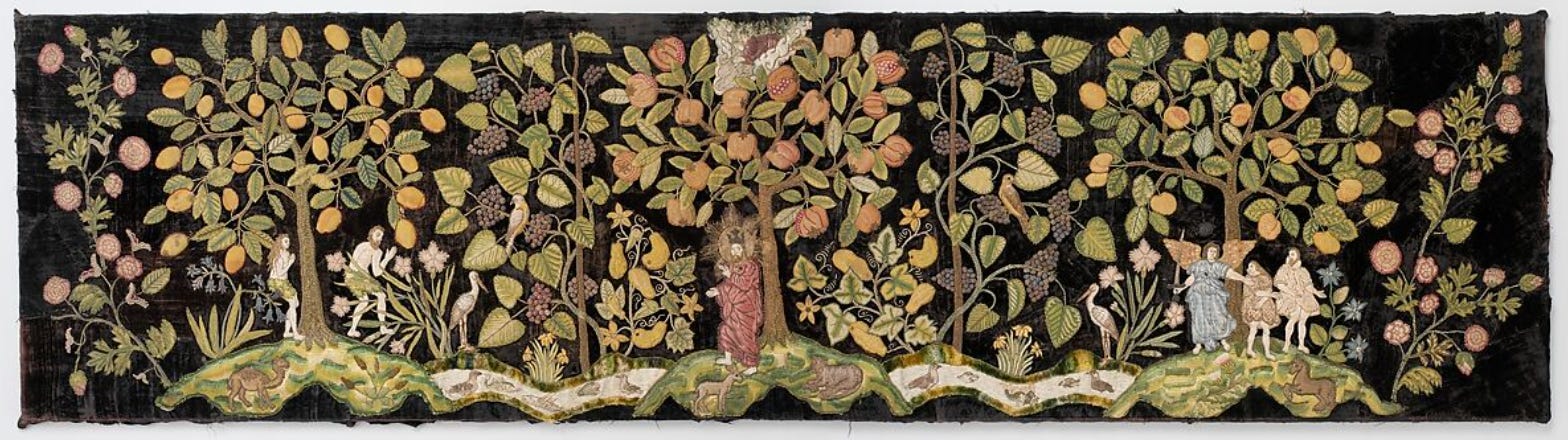
Why does this matter? Don’t miss this. This poetic language is hyperlinking back to the creation story and Lady Wisdom is supposed to remind us of Eve—the one “at his side" in verse 30 co-creating, co-ruling with God. Proverbs 2:18 comes right out with it: “She is a tree of life to those who embrace her…”

The poetic dialogue between father and son is making clear to the listener that Lady Wisdom and Lady Folly are not actually real women, but rather literary devices. Lady Wisdom reminds us of God’s Wisdom, pointing us all the way back to the garden and God’s power at work in creation, establishing for us a the way to life and inviting us to join Him in its stewardship. Duane Garrett in Holman Illustrated Bible Dictionary says this:
“When she [Lady Wisdom] claims to have been present when God created the world, concluding with the assertion that ‘all who hate me love death,’ she means that her principles are woven into the fabric of life. God made the world according to the precepts she teaches; therefore any person who disregards her fights against the very nature of reality.”
(Garrett, 2003, p.1660)
We remember what happens in the Garden narrative, right? Eve is enticed to go another way, to do what is right in her own eyes. She and Adam eat the fruit, thus cutting themselves from the Tree of Life. The consequences extends to all of us.
Our direct access to the Tree of Life, the center of God’s good world is cut off and the way of Lady Folly, the way to death, is blown wide open.

Let’s examine how the theme of women plays out in the life of Solomon. You’ve likely heard about his infamous harem of wives, but there are actually a few women in his story who are mentioned with some individualized detail.
Bathsheba - his mother who reminds David that Solomon should be king. (1 Kings 1)
Pharaoh’s Daughter - the foreign queen for whom he builds a massive palace. (1 Kings 3)
Two Mothers - the women who both claim to be the mother of a baby and come to Solomon for a resolution. (1 Kings 3)
Queen of Sheba - the foreign queen who hears of Solomon’s fame and our focus for today’s reading.
Read 1 Kings 10:1-9
What does it say? A foreign Queen heard about Solomon’s fame AND she heard about his relationship to the LORD so she came to test him. She came with a “very great caravan.” When she tests him, she is overwhelmed by the depth of his knowledge and the splendor of his wealth. Her response is to praise the God of Israel.
Why did it matter? This is not the only time royalty has come to test his wisdom. Proverbs 4:34 mentions that men of all nations came to do this, but what I particularly love is that the only one we get any detail on happens to be a woman.
The Queen of Sheba shares some commonalities with Lady Wisdom, and even Eve. Consider that she’s powerful, bringing riches to the King just as Lady Wisdom has riches and honor in her left hand. She wants to discern truth and uses her intellect to do this. She makes sound judgments and ultimately directs praise back to God. Much like Eve, she is a ruler with power and resources looking to be in the proximity to wisdom so that she can partner with Solomon in ruling and reigning.
Read 1 Kings 11:1-6
Practice answering for yourself: What does it say?
Why did it matter? Solomon’s foreign wives look a lot like Lady Folly leading him down the path of destruction. Once again, his actions demonstrate a heart led astray from the call of kings in Deuteronomy 17.
I’m struck by the sad ending to our story of Solomon—a man who spoke with God, who knew God’s laws, who ruled with more wealth and honor than any king ever before, and yet in his old age was led astray. It’s a sobering reminder that we are never too old or too experienced that we don’t need to stay connected to the vine.

I’m so excited to spend a few minutes on what scholars call the epilogue of Proverbs. I wonder what preconceived ideas you may already have about Proverbs 31? Pause for a moment to reflect and then ask God for an openness to consider how the context you now have in approaching Proverbs may change the way you approach this beautiful closing.
Start by noticing that the very first verse tells us that these are the sayings of King Lemuel and they are the things his mother taught him. Who is King Lemuel? Scholars have a few thoughts and I’ll simply share those for your consideration:
Jewish tradition has sometimes said this is another name for Solomon which would mean it’s Bathsheba talking.
The Septuagint (Greek translation of the Hebrew bible) has said it was God speaking, but God doesn’t have a mother so that’s a bit confusing.
The most commonly accepted thought is that Lemeul was a foreign king from the Massa region near northern Arabia.
Read Proverbs 31:10-31
What does it say? A woman of noble character works incredibly hard with her hands, trades, buys fields, cares for the poor and needy, sews, and wears beautiful clothing. She has a husband who is respected. She speaks wisdom and instruction. She laughs of the days ahead because her future is secure.
What’s interesting is that she never seems to sleep. She gets up while it is still dark, but her lamp also never goes out at night? This is the first clue that perhaps we’re not talking about a real woman.
Why did it matter? Friends, this is an alphabetical acrostic poem with each line beginning with the next letter of the Hebrew alphabet. In other words, it’s poetry, not prescriptive. Women everywhere should be breathing a sigh of relief. Scholars believe alphabetical acrostic poetry was used to demonstrate completeness of thought about a certain theme and even structure in a way to help with memorization. This technique is also seen in the Psalms multiple times (25, 34, 111, 112, 119, 145, and some of Lamentations). In other words the strong woman of Proverbs 31 is not an afterthought, but a summation of wisdom meant for early Jewish readers to memorize and thus live out.

And because I can’t stop, please notice that some of her descriptors have a direct link to Lady Wisdom:
“She is worth far more than rubies…” (v. 10)
“Faithful instruction is on her tongue…” (v. 26)
“She laughs at the days to come …”(v. 25)
And at the very end, where do we find her? At the city gate receiving praise
My most favorite point about Proverbs 31 is that the word we have often heard as “virtuous” actually means something very different than purity. Chayil (pronounced khah-yil, חַיִל) is a masculine noun meaning valor, strength, efficiency. It’s used in relation to an army, horse strength particularly the legs, and even virility in some places!
We find this same word used in Ruth 3:11 when Boaz calls Ruth a woman of valor (eshet chayil), but what is particularly beautiful about his use of the word is that at the time Ruth is a single woman with no children. She is a widow, poor, and foreign. Her valor has absolutely nothing to do with her marital status, her ability to bear children, her domestic prowess, or even her status in the community.
And lastly, remember that I noted the Queen of Sheba came with a great caravan. The word used to describe her caravan, actually her army, is chayil. (H2428 for those who want to go deeper with a concordance).
Why am I laying out all of these small details? Because I believe we’ve simply gotten it wrong interpretively for far too long. We’ve held out the Proverbs 31 woman as an impossible standard for women to live up to, when in actuality this passage is not really about women at all—not any more than Lady Wisdom and Lady Folly are about actual women. What we’re seeing is a demonstration and summation of wisdom characterized as a woman displaying all the excellent qualities of wisdom at work.
Rather than live in the shadow of an unattainable example, I’d rather live into the valor given to me by God who so esteems women that His poetry reflects that in its depictions of the way to life.

When Eve was with God in the garden, she had direct access to the Tree of Life. She lived in the very fullness of God’s wisdom, but when she turned away, her access was cut off. The imagery is dense: a cherubim and a flaming sword blocking the way back in not only for Adam and Eve, but also for us.
So the question for the modern reader becomes simply how do we get back to the Tree of Life? How will we ever get back to the fullness of God’s wisdom in the garden?
In Lesson 2, we looked at John 14 when Jesus calls himself the is Way, the Truth, and the Life. He was responding to their desire to go with him and it’s so utterly relatable, isn’t it? Our hearts cry along with Thomas in John 14 when he said “Lord we don’t know where you are going so how can we know the way?” (v. 5).
In the Old Testament wisdom is personified as a woman, but in the New Testament wisdom is personified in Jesus. This is central to our understanding of how to apply the wisdom of Proverbs to our lives right now. In claiming to be the way, the truth, and the life, Jesus is inviting us to join him on the way back to the garden. This will lead us through His death, poignantly also by way of a tree, and will culminate in a city where the enthroned King will be with us once again in the redeemed and renewed creation.
The way of wisdom is the way of Jesus…all the way back to a garden.

Questions for reflection
What voices do I hear calling out from the city gates?
What does Jesus’s voice sound like and what invitation does He make to me?
Who else is straining to hear Wisdom and how do I connect with them?
What do I know now that I didn’t know before I studied Proverbs?
Reminders from Proverbs & the life of Solomon
Wisdom is not found within us. Wisdom is given by God generously when we ask.
The Way of wisdom is less about which path to take and more about who we are following.
Wealth is a blessing given by God. It is a tool with both boundaries and essential functions to be stewarded with wisdom from God.
The wise way to use words is in response to God’s movement toward us and pointing in the direction of God’s promises.
Wisdom in Proverbs is personified as a woman with the Proverbs 31 woman held out as the summation of God’s wisdom on full display.
Following Jesus is the way we get back to the Tree of Life.